Saturday, October 15, 2022

The Rise of Mechanical Philosophy


Note: All posts are interconnected, so you are requested to read the previous posts before reading this post. 

After the Renaissance, the spirit of open inquiry mainly flourished outside of the Church. The book De Revolutionibus Orbium Celestium by Polish astronomer Nicolaus Copernicus was published just a few days before his death in 1543 and is often praised as the forerunner of the spirit of free inquiry. Copernicus advocated a heliocentric view of the cosmos (i.e., a stationary sun with other planets, including the earth, revolving around it) in this book, as opposed to Ptolemy’s geocentric theory (i.e., stationary earth at the center with other heavenly bodies, including the Sun, circling around it), which was believed as Church’s ‘official’ theory. This view was a serious attack and a challenge to Christian Philosophy. So, Copernicus's theory was pronounced “false and altogether opposed to Holy Scriptures”.  A similar case was with Galileo when he was imprisoned in 1633. It was a period when a lot of confrontations took place between the Church and the protagonists of free inquiry (the scientists). Over time, the Church was finally proven to be incorrect, and it was forced to make an unseemly retreat from its position. The Church ultimately adopted the heliocentric perspective in 1982 and Darwin’s theory of evolution in the late twentieth century. As a result, the intellectual authority of the religious thinkers was utterly shattered within a few centuries, thereby putting the Christian worldview to rest. 

     During the 16th – 17th century, scientific development gave birth to a new worldview where that of the world replaced the notion of interconnectedness, underlying unity, purposefulness, interconnectedness, etc., as a mechanical system, i.e., an only machine with no purposefulness. Copernicus, Kepler, Galileo, Bacon, Descartes, and Newton actively contributed to spreading this worldview. Bacon can be credited to the advent of this worldview mentioned in his classical book Novum Organum  in 1620. Unlike Aristotle and Plato’s philosophy, Bacon’s approach was based on experimentation, data gathering, and analysis to unravel Nature’s truth systematically and organized. He believed science is a tool for only the betterment of human beings at any cost paid by Nature. Therefore, he stressed that rather than asking the metaphysical ‘why’ of things, the science of learning should be committed to the ‘how’ of things.

     Renes Descartes (1596 – 1650), another analytic philosopher, a great scientist and mathematician, systematically initiated the task of explaining the ‘how’ of numerous phenomena already known by the seventeenth century. He believed in breaking up problems and thoughts into smaller parts and then rearranging them systematically in a logical order. This theory became an essential characteristic of science and prevailed in the scientific community. However, the theory spread a ‘reductionist’ and ‘fragmentary’ approach, unlike an integrated and wholeness approach that prevailed during the earlier Greek philosophers. The process originated a completely new mode of thinking that has come to be known as Mechanical Philosophy. Basic to this mechanical philosophy is Cartesian Dualism. “All of reality, he argued, is composed of two substances. What we may call spirit is a substance characterized by the act of thinking; the material realm is a substance the essence of which is an extension. Res-cogitans and re-sextensa – Descartes defined them in a way to distinguish and separate them absolutely. To think of substance one cannot attribute any property characteristic of matter – not extension, not a place, not motion. Thinking, which includes the various modes which mental activity assumes, and thinking alone, is its property. From the point of view of natural science, the more important result of the dichotomy lay in the rigid exclusion of any and all psychic characteristics from material nature (Westfall, 1971). ” To Descartes, the matter was thus really dead and possessed no activity except motion derived from God in the beginning. He visualized the whole Universe from the same perspective. He concluded that Nature is made of various disconnected parts and can be completely described in terms of the movements and arrangements of its parts.  This mechanistic visualization of Nature became a widespread dominant paradigm in the then scientific community in every emerging field,  for example, living organisms: the seventeenth-century’s physiologists tried to explain bodily functions such as digestion, blood flow etc. from the same perspective; Cell Theory: the biologist recognized that all animals and plants are made of cells and compared body as a factory where cells are produced, assembled and distributed in body; Genes: the biologists of twentieth-century found that all the biological structures could be understood in terms so molecular structures unlike cells during nineteenth-century; Mechanistic Medicine: by concentration on the smallest part of any organism, the healing of human body shifted to cell and then finally to molecules which lost the vision of human being as a whole. Descartes visualized even organic phenomena from the same perspective. He described men as a machine that performs all physiological functions of a man – circulation, digestion, nourishment, growth and perception. Newton intensely participated in the same direction by introducing the concept of force to already existing notions of matter and motion. Newton saw particle forces as ontological realities, and he was modest enough to concede that he had no idea what caused them; in fact, he linked them directly to God’s intervention. But his French followers believed that the Newtonian system only validated the Cartesian vision of reality as a great machine. The references to God made by Newton and Descartes were quickly dismissed as superfluous and overshadowed by the successes of their mathematical mechanics. Newton had called God’s mercy to restore order to the solar system after it had become drenched, either due to external factors (comets etc.) or due to its inherent character. When Laplace demonstrated that disturbances caused by mutual forces or external bodies like comets were only transient and that the Solar System was intrinsically stable, it was considered as another ‘evidence’ of God’s redundancy. All of this resulted in a resurgence of materialism – a belief that hard stuff in unyielding lumps is the Universe’s solitary ultimate reality.

Impact of the mechanical philosophy on Social thought

The application of mechanical philosophy to sciences dealing primarily with human and social institutions resulted in the materialistic worldview.

    One of the first systematic attempts of this kind was made by John Locke in the late seventeenth century. He was so much influenced by the ‘reductionist’ or ‘fragmentary’ approach that he visualized society from an atomistic perspective. He considered an individual the smallest unit (basic building block) and tried to understand the ‘natural laws’ governing individual behaviour. He found the natural laws, including personal interest, to protect and allow for the increase of the property of its members, freedom, etc., denying any connection between people and God. In this way, he successfully separated religion from people’s activity as well as integrated concerns related to society.  The consequences of this monumental is best put in the worlds of Rifkin and Howard:

“Having removed God from the affairs of people - as Bacon had removed him from nature – Locke was left with human beings all alone in the Universe… Now, men and women became just what Bacon, Descartes and Newton had made of nature: mere physical phenomena interacting with other bits of matter in the cold, mechanical Universe. This being the case, on what basis could a social order be formed?... Once we cut through useless custom and superstition, argued Locke, we see that society, made up solely of individuals creating their own meaning, has one purpose: to protect and allow for the increase of the property of its members. Pure self-interest thus becomes the sole basis for the establishment of the state, … for reason leads us to conclude that this is the natural order of things…”

In this way, the personal goal of salvation during the medieval ages shifted to achieving things and ensuring personal interests. This ensued the idea of progress.

    Adam Smith, a Scottish economist of the eighteenth century, also recognized selfishness as something ‘natural’ and did not like the idea of erecting social and moral barriers to its pursuit. Smith, based on Locke’s idea, formulated a theory of economics and concluded laissez-faire- the general principle of non-interference with the free action of the individual, is the most efficient method of economic organization and instead believed that there was an ‘invisible hand’ of ‘Providence’ which governed the economic processes so as to “make nearly the same distribution of the necessaries of life which would have been made had the earth been divided into equal proportions among all its inhabitants”. Unfortunately, the “invisible hand” of ‘Providence’ did not act as Smith had predicted, and his laissez-faire philosophy simply served to promote the pursuit of material abundance to meet physical demands, with little regard for ethics. This ethical evasion became the trademark of all subsequent mainstream economists, resulting in the assumption that what is ‘pleasant’ is ‘good’ and what is ‘unpleasant’ is evil. By this way, under the influence of Newtonian physics, the human movement was considered merely a physical movement under the various forces of attraction or repulsion. The overall philosophy of utilitarianism, which was first articulated by an Englishman named Jeremy Bentham, is based on these ideas, and is summed up in Bentham’s famous phrase:

“Nature has placed mankind under the governance of two sovereign masters, pain and pleasure. It is for them alone to point out what we ought to do, as well as to determine what we should do ”

The message of Bentham’s phase is very clear that men should act in a manner that maximizes their ‘pleasure’ and minimizes the ‘pain.’ It implies a theoretical framework justifying a materialistic worldview. When social philosophers like Herbert Spencer interpreted Darwin’s theory of evolution to sanctify the philosophy of ‘survival of the fittest ’ as a law of Nature, the journey of modern civilization to the pinnacle of a materialistic worldview was nearly complete.

Renaissance


Note: All posts are interconnected, so you are requested to read the previous posts before reading this post. 

The Renaissance bridges the middle and modern ages. Classical literature written by Greek and Roman philosophers was rediscovered during this period, which gave birth to Humanism – a philosophy that keeps humans and their potential at the centre and flourished in Italy due to its less adamant environment. The exposure of Greek and Roman ideas encouraged the rationality of all the then rational people and prepared a conducive environment to spurt rational and scientific frame of mind.  In the late Renaissance, Leonardo da Vinci (1452-1519) was a pivotal figure. He made significant contributions to engineering, architecture, physics, urban planning, mapping, philosophy, and anatomy throughout the Renaissance and is considered one of the greatest artists of all time. As an artist, he presented his knowledge visually, which appealed to many. He propagated that an artist is able to project an intimate connection between the form and the understanding of its underlying principle.          

Saturday, August 20, 2022

The Christian Worldview


Note: All posts are interconnected, so you are requested to read the previous posts before reading this post. 

Plato’s philosophy, like Socrates, was not easy to digest for many of their times. Even Plato’s students considered some of his concepts too ‘idealistic.’ However, he profoundly influenced the early fathers of the Church and, through that, the Christian Worldview. At that time, the western world was imbued with the Christian Worldview that dominated the world for over millennia. Plotinus, one of the most influential philosophers in ancient times after Plato and Aristotle, founder of Neoplatonism, A philosophical and religious system developed by the followers of Plotinus in the 3rd century A.D., and one of the Neo-Platonists[1], gave a new height to Plato’s thought through his rationality and reasoning. After that, a number of Plato’s doctrines, e.g., his doctrine of two worlds – the ultimate reality of the Universe is not the world of senses which we perceive, but the spirit, were easily and readily accepted in Christian theology largely by way of St. Paul, Origen and St. Augustine. Accordingly, at that time, the real purpose was considered as ‘salvation’ rather than achieving materialistic things.

During the entire span of the Middle ages, the philosophy widespread propagated by Christianity was certainly anti-materialistic. It is not to say that, during the Middle Ages, Western society was a biblical utopia, but there was a profound influence of Christianity and its worldview of salvation. Initially, Jewish adopted Christianity. Paul, one of the most influential philosophers in antiquity after Plato and Aristotle, was considered the then ‘father of the Church’, can be credited to spread Christianity by traveling all over Rome. In the beginning, conservative Romans rejected Christianity, considering it a threat to their religious system because they believed that the emperor protected society.

On the contrary, the Christians believed that only God protected everyone and everything. Consequently, they refused to worship the then emperor. As a result, Romans started punishing them brutally. Roman brandished Christians as heretics, and they had to face persecution and even death for defying the ‘state God.’ Many were tortured brutally and even torn to pieces by wild animals. But, the Christians faced persecution with such confidence that the people forcibly began to think that their religion must be true. Another reason for the acceptance of Christianity was its teaching promised a better life (salvation) after death which the Roman religion could never ensure. Slowly their numbers increased. In the fourth century A.D., Christianity became the state religion of the Rome Empire when the then Roman emperor Constantine embraced it. The corruption, civil wars, etc., lured the Barbarian tribes into attacking, which weakened the Rome Empire and strengthened Christianity. The Christian monasteries – especially those started by St. Benedict- made a deep impression on the minds of the barbarians, for they could see for themselves that man could really have a blissful life after renouncing all worldly pleasures. Gradually, the Barbarians ‘softened’, and even their leaders were attracted to Christianity. Consequently, during the early middle ages, the goodwill between the rulers and the Church deepened to such an extent that the Church acquired an almost independent status governing the spiritual life quite at par with the political state which governed the secular life.

Thus, it would not be wrong to say that the Christianity worldview during the Middle Ages prevailed in the Western world for over a millennium. However, various internal confrontations within Christianity with increased wealth and power shook people’s faith in Christianity. But, the succession of intellectual shifts, solidified during the 14th and 15th centuries, are considered the main reasons for the demise of this worldview. For example, the revival of Aristotelian, followers of Aristotle or his teaching, work in the twelfth century, primarily based on deductive logic and an inductive analytic method, attracted medieval thinkers to question some of the practices of the Church; One of the earliest thinkers, Peter Abelard, set down one hundred and fifty-eight propositions in his book Sic et non (translated as ‘Yes’ and ‘No’) through which he brought out the contradictory nature of the church doctrine. He always focused on advocating the supremacy of reason over faith: “A doctrine is believed, not because God has said it, but because we are convinced by reason that it is so”. A number of logical developments happened during the 15th  – 16th century. That era is known as the Renaissance. The next post briefly describes the development during Renaissance.


Friday, August 12, 2022

Socratic-Platonic Thought


Note: All posts are interconnected, so you are requested to read the previous posts before reading this post. 

In the last post, we discussed the pre-Socrates period, where the philosophers explored wholeness and its parts with their roles. The section discusses Socratic-Platonic thoughts focusing on individual virtues, happiness, right knowledge, etc., instead of the Universe and its constituents.

Socrates, a Greek sage and philosopher of the fifth century B.C. from Athens, was the herald of a silent revolt against the living highly based on material possessions and imbued with power and wealth along with inhumanity. The below statement given by Mumford can help us visualize the materialistic life of that period:

“The ruling classes constantly were enervated by the surfeit of goods and pleasures they had so ruthlessly monopolized for themselves. They had lapsed, too may of these insolent rulers and their agents, from a human to a distinctly simian level; like the apes, they snatched food for themselves instead of sharing it with the froup; like them too, the more powerful claimed more than their share of women: like them again, they were in a constant state of nettled aggression toward possible rivals. In short, they had alienated themselves from their distinctly human potentialities….”

 During such an era, Socrates challenged all the vanities and pomps of a materialistic worldview through his simple life and powerful teachings. He was very much concerned with the question of virtues viz. justice, piety, moderation, etc., culminating in human happiness. He believed that happiness depends not on external objects and luxurious life but on knowingly acting rightly. To achieve a good life, he believed people should focus on moral virtue rather than pursuing material wealth because virtue that consists of the right knowing always leads to the right actions. However, he did not indicate how one could obtain that virtue. According to him, one can achieve righteousness by questioning one’s moral beliefs. That’s why he was also known as a moral philosopher of that time. In his trial speech, he tries to explain the substance of his mission (Graham, 2016):

“Men of Athens, I appreciate and love you, but I will obey the god rather than you, and as long as I draw breath and have the ability, I will not stop philosophising and exhorting you and appealing to any one of you I happen to meet, saying what I always say, “Good sir, since you are an Athenian, a citizen of the greatest city and the one most renowned for wisdom and power, aren’t you ashamed of yourself for devoting yourself to maximising your wealth, your reputation, and your rank, while you show no interest at all in how to improve your wisdom, your honesty, and the state of your soul.”

 The philosophy of ‘right knowledge,’ propagated by Socrates, can be understood by the writings of his students, especially Plato. He concluded that ‘right knowledge’  free from all possibilities of errors of perception and judgment could not be achieved through senses because our senses are transient, continually changing and subject to decay and death. Thus, sensual perceptions are not enough to conclude this world objectively.

 The idea of ‘Good’, wisdom etc. belong to the super-sensible world (in contrast to objects which constitute the sensible world), and in Plato’s own words;

“…. in the world of knowledge, the idea of good seen, is also inferred to be the world of knowledge, the idea of good seen, is also inferred to be the Universal author of all things beautiful and right… the immediate source of reason and truth.. and that this is the power upon which he who would act rationally either in public or private life must have his eye fixed”.

In Plato’s philosophy, we thus find a consummation of Socratic teachings. Socrates taught that true happiness – the perfect realisation of one’s ‘being’ -  needs right action, which demands ‘right knowledge.’ This knowledge could dawn only with a clear understanding of the idea of ‘Good’, and Plato indicated that ‘divine contemplation’ of the super-sensible world would reveal the idea of ‘Good.’ The perfection of man thus necessitated a knowledge of super-sensible realities. Accordingly, in his Academy too, Plato emphasized ‘enlightening’ his students, creating a love of knowledge and wisdom rather than imparting any special skill.

  We thus find that Platonic philosophy is a complete antithesis of the materialistic worldview. Like Socrates, he mocked all attempts at finding happiness in the ‘sensible world’. He considered people who thought to become happy only from sensual pleasures as prisoners of an underground cave where one can never see anything else other than the shadows on the wall of their cave, and they assume the shadows as realities. It implies that people searching for happiness only in the domain of their sensual pleasures are unaware of their virtue and realities. True happiness lies in coming out of this ‘prison house’ of the ‘world of sight’ and willfully undertaking the prisoners’ journey out of the cave. He believed this was the real purpose of truly human life.

Thus, being practical moral philosophers, Socrates and Plato much focused on individual virtues that culminate in human happiness. They condemned happiness and values derived only from senses and advocated that ‘right knowledge’, which could not be possible with temporary senses, is required to get the virtues. Hence, the Socratic-Platonic thought was the antithesis of the materialistic worldview prevailing in the modern worldview.

 After briefly understanding Socratic-Platonic thoughts, we can now move towards ‘The Christian Worldview,’ which dominated the western world for over millennia.


NOTE: Kindly comment if you have any input to improve the post. 

Thursday, August 11, 2022

Worldviews of the Pre-Socrates Philosophers


Note: All posts are interconnected, so you are requested to read the previous posts before reading this post.   

The last post discussed the materialistic worldview - full of inherent contradictions and dilemmas. If you have not gone through it yet, read the previous post before reading this section, as all posts are interconnected. It is important to note here that the materialistic worldview that has influenced the globe and is being adopted worldwide, irrespective of the religion, cast, creed and even geographical area, did not even exist before the fourth century B.C. In fact, interestingly, it was quite the opposite those days. The then philosophers are known as Pre-Socrates Philosophers. It will be an exciting journey to learn about their worldviews because many of us, especially those who are born in the modern era full of materialistic happiness, may not be able to think of worldviews other than the materialistic. This section unfolds the worldviews of the Pre-Socrates Philosophers, which were not materialistic at all.

Thales, Anaximander and Anaximenes, who lived in Miletus city in Greek in the sixth century B.C., are considered the ancestors of philosophies in western civilization. They were curious to know about the Universe and its fundamental substances. Therefore, questions like who created the Universe, how does the Universe work? etc., were at their priority. They tried to understand the Universe from the point of view of inherent natural laws rather than any God’s action or supreme power. So, they are often called ‘naturalists’ or ‘cosmologists’.

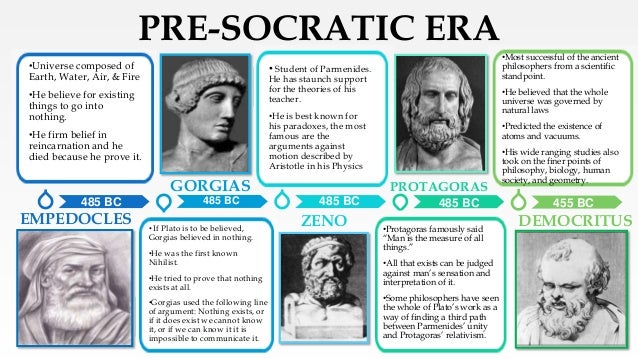
They observed two fundamental characteristics of reality: first, everything in the world is changing with time: second, any single thing that exists is different than anything else that exists, has existed and will ever exist. They concluded that a single and permanent substance underlying all the dynamic changes occurring in the perceptible world retains its unity and fundamental identity, termed as ‘Arche’. The Milesians saw the Arche as a physical or bodily material, as opposed to the concept of an immaterial soul or pure intellect. However, at the same time, this underlying essence was regarded as alive and endowed with spirit, and it was deemed divine and imbued with intelligence. Each Milesian offered a different view about what the Arche is made of. For example, Thales proposed that Arche is made of water, which implies water is an underlying substance of everything. Empedocles (fifth century B.C.) claimed that the combination of four elements (earth, water, air, and fire (or light) is the root cause of all the manifestation in the material world. Anaximander believed Arche not to be any material substance because of its limited nature. So, he called Arche as ‘Aperion’ -something is absent of limitations or limitless- which implies all-pervading. Anaximenes proposed Arche as ‘Air’. From an atomistic perspective,         Democritus, half a century after Empedocles, visualized the material world as composed of atoms of various shapes and sizes. He believed that all the observable dynamic properties are the combinations of atoms inside the objects. Epicurus, who extended the teaching of Democritus, restated the atomic perspective and said that whatever exists results from the recombination of atoms.

There was another view about the Universe based on the analogy of ‘Microcosm’ and ‘Macrocosm’. For earlier Greek philosophers, the world was a kosmos- ultimately ordered and harmonious structure which implies that each unit of this world is in harmony placed purposefully with other parts, and the characteristics of the whole Universe reflect on its parts. Microcosm and macrocosm are two components of an ancient Greek philosophical theory that describes humans and their role in the Universe. These early thinkers considered the individual human being as a small world (mikros kosmos ), whose composition and structure matched that of the Universe, or big world (makros kosmos, or megas kosmos ). This can be understood from Philebus and Timaeus, where Plato argues that humans and the Universe both have a fundamental body and a rational soul. The human soul must derive from the Universe’s soul, just as the human body does from the Universe’s body. As a result, the cosmos is not only a well-ordered system but also an intelligent creature.

The above discussion implies that the earlier Greek philosophers used to think of inherent unity, the interconnectedness of various parts of the Universe, the proper role of various substances, orderliness and purposeful integration of all substances. They were more interested to know the inherent underlying natural laws of which the whole world is a manifestation. This kind of worldview prevailed during the pre-Socrates period when philosophers used to explore wholeness and its parts with their roles. 

NOTE: Kindly comment if you have any input to improve the post. Click on Follow to get the latest updates. 


Friday, August 5, 2022

Prevailing Worldview and its Impacts


Note: All posts are interconnected, so you are requested to read the previous posts before reading this post. 

Materialistic Worldview (A worldview of crises)

A materialistic worldview is a worldview where a human being is considered the only body, happiness is seen as sensual pleasures, Nature is seen only as a resource to gratify sensual pleasures and relationships are recognized only if there is a materialistic gain. This worldview has dominantly influenced the modern era. But since all the sensory interactions are inherently transient in Nature, this can never lead to sustainable happiness. In an attempt to make it perpetual, continuous effort is made to maximize and perpetuate happiness through this mode by trying to evolve and indulge in more and more pleasurable material interactions of newer kinds. This naturally gives rise to ever-increasing `consumerism' or the tendency towards unlimited material needs. It is also responsible for the widespread modern ethos for profit maximization and increasing accumulation of enjoyable goods and services. The fallacy inherent in this perception can easily be recognized as, on the one hand, it directly leads to exploitation of the natural environment, in an uncontrolled manner, as well as other human beings leading to strife, disparities, violence and continuous environmental degradation; on the other hand, it is also responsible for engendering restlessness, tension, insecurity, fear, psychological problems and other incongruities within the human beings. Therefore, it proves counter-productive on all fronts. Any effort carried out under this worldview to perpetuate happiness, in fact, results in increasing misery on all fronts.

Further, under the influence of such a perception of happiness, efforts to ensure prosperity (which essentially implies the feeling of adequacy in fulfillment of our material needs) manifest in the form of triggering more and more accumulation of enjoyable goods and services. And yet one keeps feeling `deprived' and wanting more and more because inherently no amount of material accumulation can make happiness sustainable. Such a propensity has also been called human greed - ever wanting more and more and as Mahatma Gandhi proclaimed;

 `Earth provides enough to satisfy every man's need but not for every man's greed'

  Inherent Dilemmas in the Materialistic Worldview

 The materialistic worldview is full of inherent dilemmas. The dilemmas are as follows:

 Undefined Growth:

The worldview motivates one to grow (in materialistic terms) more and more. However, the term 'Growth' is not defined yet and has a very vague meaning. That's why people make their own definition of growth. There is no line defined when we can say there is now enough growth and no need to move further. Everyone is following undefined growth, which ultimately culminates in dissatisfaction and unhappiness in an individual.

 The dichotomy in removing poverty with undefined prosperity line

The poverty line is generally established but not the prosperity line, which is primarily defined as the acquisition of increasing wealth. Such ill-defined affluence has widened the divide between affluence and poverty, both worldwide and inside countries, and poverty will continue to exist on the planet. Thus, all wholeheartedly efforts on poverty eradication result in marginal impacts. It can be understood through the following example: the difference in per capita income between the North and South tripled from $5,700 in 1960 to $15,000 in 1993. The richest 20% of the world’s people now own 85% of their wealth, while the poorest 20% (who account for 80% of the total world population) own just 1.4% .

 The Hesitation in Adopting Sustainable Consumption (SC)

The following reasons, in the form of hesitations, have been identified while adopting sustainable consumption; 

(i)             With the prevalent notion of the growth in society, if we consume less, it is seen as “low quality of living standard” (Living high quality/status of life means higher consumption). Thus, it results in a hesitation to live in a nature-friendly manner for sustainability.    

(ii)           It becomes a challenge for an individual, who has grown up with the materialistic worldview, to break one’s habits based on materialistic taste, the social pressure of standard of life, high consumption, etc.  

 It is interesting to note that modern development keeps following undefined and ever-increasing growth promoting tendencies for higher consumption, while we talk about sustainable consumption.


    In the present state of society, it is apparent that people are so much indulged in seeking sensory happiness primarily from materialistic things. Subsequently, the prevalent propensity to maximize sense gratification is now believed to be a perfectly ‘normal’ propensity and culminated in the belief that happiness lies only in sensual pleasures. The materialistic worldview is now so entrenched in society that it is now even difficult to visualize any alternative. 

    Though, the worldview in Ancient Greek (before the fourth century B.C.) was quite the opposite of the modern worldview, which gradually changed and culminated in the materialistic worldview. The next post primarily discusses the changes in worldviews during the medieval ages.

Thursday, August 4, 2022

About Worldview


About Worldview

Each one of us sees the world according to one's perspective. That's why we see Existence, Nature, ourselves, relationships with others, happiness and prosperity differently. One may see Existence/Nature from a purely scientific perspective; the other may see this world from a spiritual perspective; some may see it from an economic perspective. In fact, many times, you have been noticing conflicting views in people about the same object or the same event. For example, our attitude towards Nature depends upon our perspective and we act accordingly. A person with an economic perspective may think of using Nature as a source to earn money; a person with a scientific perspective may think of physical-chemical laws working in Nature; a person with a spiritual perspective may think about the purpose of Nature. Now these three persons sitting together may conflict while talking about Nature.

Our perspectives are actually responsible for our happiness or unhappiness. For example, people may have different views about a falling leaf from a tree. One may conclude that the tree has left the leaf as its work is over. Similarly, the world will leave me one day. Therefore, there is no need to think about the world; self-enjoyment is the only way to live. Another one may conclude that the leaf has got mixed into the soil. In the same manner, one day, I will also be a part of the soil and no relationship will continue with me in the future. Therefore, there is no need to attach to anyone and self-centric living is the only way to live a life. Another one, observing the same event, may conclude that the leaf was participating in the tree's growth till it was with the tree. Having separated from the tree, now it is participating in the soil. Therefore, one should continuously ensure participation with everyone (either living or non-living) in every place. Thus, our conclusions based on our perceptions make us happy/unhappy.

Worldview is the way of seeing and interpreting the world. The worldview of a particular time is the view regarding the ultimate realities of existence. It refers to the perception which has a dominant influence on people in any particular era and affects policy-making, planning, etc. It does not imply that such a view is held by each and every individual, which definitely differs at any point in time.

Needless to emphasize, our worldview affects all aspects of our life, namely lifestyles, behavior, economic activities, social set-up, technological systems, etc. 

In any particular era, a worldview may be based on an understanding of Existential realities or assumptions about realities. If a worldview is based on existential realities which are actually universal, it creates a conducive environment where people can live harmoniously and happily; otherwise, it creates a conflicting environment. In other words, we may say that if there is a conflicting environment in any particular era where people are fighting, dominating, or thinking of exploiting for their short-term benefits, the worldview is not based on the understanding of Existential realities. In fact, the worldview is based on some wrong assumptions about the realities.

 "A WORLDVIEW BASED ON THE EXISTENTIAL REALITIES CREATES A HARMONIOUS LIFESTYLE FOR PEOPLE"